


For decades, Service Level Agreements (SLAs) have been the backbone of IT service management. Organizations have relied on metrics such as response times, resolution times, uptime, and availability to measure service performance and hold providers accountable.
These metrics remain important. However, in today’s digital-first workplace, they answer only one question:
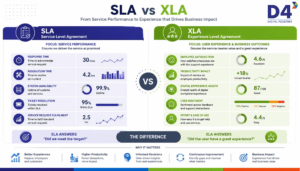
“Did we meet the target?”
What they often fail to answer is:
“Did the user have a good experience?”
This shift in perspective is driving the growing adoption of Experience Level Agreements (XLAs) – a framework designed to measure the quality of user experience rather than just operational efficiency.
The Limitation of Traditional SLAs
Imagine an employee reports a critical email issue at 9:00 AM.
The IT team responds within the agreed 30-minute SLA and resolves the issue within four hours. On paper, the service desk has performed successfully.
Yet the employee may have missed an important client meeting, lost productivity, or experienced frustration throughout the process.
The SLA is achieved, but the user experience is poor.
This highlights a growing challenge for modern organizations: operational success does not always translate into business success.
What Makes XLAs Different?
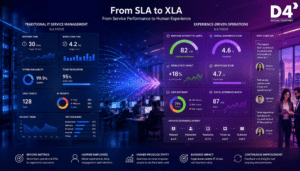
While SLAs focus on technical performance, XLAs focus on human outcomes.
XLAs measure factors such as:
-
Employee satisfaction
-
Customer satisfaction
-
Productivity impact
-
Ease of service consumption
-
Digital experience quality
-
User sentiment and feedback
Instead of simply tracking how quickly a ticket was resolved, XLAs evaluate how effectively the service enabled users to perform their work.
In other words, SLAs measure service performance; XLAs measure service value.
Why Organizations Are Embracing XLAs
The modern workplace has evolved dramatically. Hybrid work models, cloud-based applications, digital collaboration platforms, and increasing customer expectations have made experience a critical business differentiator.
Organizations are realizing that users care less about internal metrics and more about outcomes.
XLAs help businesses:
-
Improve Employee Productivity – By identifying friction points in digital workflows, organizations can reduce downtime and improve efficiency.
-
Increase User Satisfaction – Experience data provides direct insight into how employees and customers perceive services.
-
Align IT with Business Goals – Instead of measuring technical outputs alone, XLAs connect IT performance to business outcomes such as productivity, engagement, and customer loyalty.
-
Drive Continuous Improvement – Experience insights reveal recurring pain points that traditional operational dashboards often overlook.
The Journey from SLA to XLA
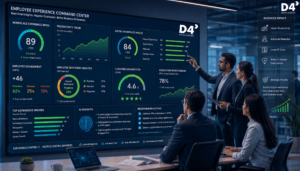
Moving toward experience-centric service management requires a broader perspective.
Organizations can begin by:
-
Mapping employee and customer journeys.
-
Collecting satisfaction and sentiment data.
-
Monitoring digital experience metrics across devices, applications, and networks.
-
Combining operational data with experience analytics.
-
Using feedback to proactively improve services.
Importantly, XLAs should not replace SLAs entirely.
SLAs ensure reliability, accountability, and contractual compliance. XLAs build upon this foundation by measuring whether services are actually delivering meaningful value to users.
The most effective organizations use both.
What Advantages Do XLAs Deliver?
Organizations adopting XLAs are increasingly reporting benefits that extend beyond IT operations:
-
Higher employee engagement and satisfaction
-
Better digital workplace experiences
-
Reduced productivity loss
-
Faster identification of hidden service issues
-
Improved customer loyalty
-
Stronger alignment between technology investments and business outcomes
By focusing on experience, organizations can move from reactive service management to proactive experience management.
What Does the Future Hold?
The future of IT service management is becoming increasingly experience-driven.
Advancements in Artificial Intelligence, Digital Employee Experience (DEX) platforms, and predictive analytics are enabling organizations to understand user sentiment in real time. Rather than waiting for complaints or survey responses, IT teams can proactively identify experience issues before they impact productivity.
In the coming years, success will be measured not only by system uptime or ticket resolution speed, but by how effectively technology enables people to perform, collaborate, and innovate.
Organizations that embrace XLAs today will be better positioned to create more productive workplaces, deliver superior customer experiences, and unlock greater business value from their technology investments.
The future is not about choosing between SLAs and XLAs. It is about combining operational excellence with experience excellence – because ultimately, the true measure of service success is not how quickly an issue is resolved, but how positively the experience impacts the people it serves.