
For years, managed services have been defined by one simple expectation: keep systems running. Success was measured by uptime, ticket resolution, and SLA compliance. If nothing failed, the job was considered done.
But today’s business landscape has changed.
Organizations no longer compete on operational stability – they compete on speed, innovation, and adaptability. As AI, cloud, automation, and cybersecurity reshape every industry, businesses need more than an IT support provider. They need a strategic partner that continuously improves their technology landscape.
That’s where Managed Services 2.0 begins.
From Operational Support to Business Enablement
Traditional managed services focused on maintaining infrastructure. Managed Services 2.0 focuses on continuously enhancing it.
Instead of asking, “Is everything working?”, organizations are now asking:
- Can this process be automated?
- Can AI eliminate repetitive tasks?
- Can cloud costs be optimized?
- Can we improve customer experiences faster?
- Can we identify risks before they become incidents?
The role of a managed services provider is evolving from solving technical issues to driving measurable business outcomes.
Innovation Shouldn’t Be a One-Time Project
Many organizations still approach innovation as a periodic initiative, planned annually and executed through large transformation programs.
The reality is different.
Every software update, cloud migration, security enhancement, workflow automation, or AI implementation presents an opportunity to improve the business.
Managed Services 2.0 transforms routine IT operations into a continuous cycle of optimization. Rather than waiting for major transformation projects, organizations innovate incrementally – every day, every release, and every improvement.
Small, continuous innovations often create a greater competitive advantage than occasional large-scale transformations.
AI Is Changing the Rules
Artificial Intelligence is redefining what managed services can deliver.
Instead of simply monitoring systems, AI can predict outages, identify performance bottlenecks, detect security threats, automate repetitive tasks, and recommend optimization opportunities before users even notice an issue.
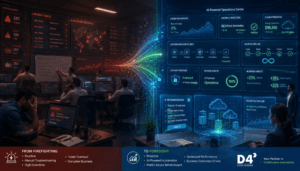
This shifts IT teams away from reactive firefighting and toward strategic innovation.
The result is faster decision-making, improved operational efficiency, better user experiences, and more time for teams to
focus on initiatives that create real business value.
Measuring Success Differently
The KPIs of Managed Services 2.0 look very different from the past.
While uptime and SLA compliance remain essential, they are no longer enough.
Leading organizations increasingly measure success through questions like:
- How many manual processes were automated?
- How much cloud spending was optimized?
- How quickly were new capabilities delivered?
- How much have employee productivity improved?
- How much business value was created through technology?
The conversation shifts from keeping systems available to helping businesses move faster and smarter.
Why the Right Partner Matters
Technology alone doesn’t drive innovation, execution does.
Organizations need partners who don’t just manage infrastructure but continuously identify opportunities to modernize, automate, secure, and optimize their technology ecosystem.
This is where D4 Insight helps organizations embrace Managed Services 2.0. By combining AI-powered operations, cloud modernization, DevOps, cybersecurity, intelligent automation, Salesforce, Microsoft Dynamics, and data engineering expertise, D4 Insight enables businesses to move beyond reactive support and build a technology environment designed for continuous innovation and long-term growth.
Because the future of managed services isn’t about preventing downtime.
It’s about creating agility, intelligence, and resilience that enable organizations to innovate every single day.
Keeping the lights on is no longer the destination. It’s the foundation for powering what’s next.