
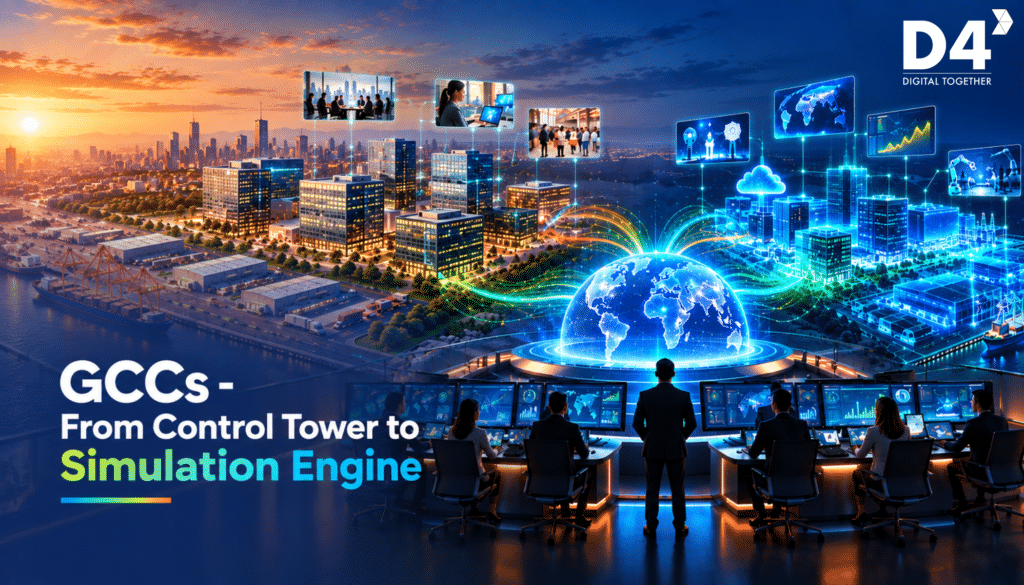
From Control Tower to Simulation Engine
Most enterprises have a digital twin of a factory.
Sensors mirror machines. AI predicts failures. Simulation tests production scenarios.
But what about the enterprise itself?
What if an organization could create a living digital replica of its customers, operations, supply chains, technology landscape, workforce, financial signals and market dynamics and use it to test decisions before making them in the real world?
That is where the next evolution of the Global Capability Centre (GCC) could become fascinating.
The GCC Could Become the Enterprise’s Simulation Layer
Traditionally, the GCC has been where global organizations execute technology, analytics, operations and increasingly innovation.
But imagine a GCC that does something fundamentally different:
It simulates.
Before entering a new market, it models the likely impact.
Before changing pricing, it tests customer behaviour.
Before restructuring a supply chain, it models disruption scenarios.
Before launching an AI agent, it simulates its downstream consequences.
Before making a major technology investment, it runs competing scenarios against cost, risk, customer experience and operational resilience.
The GCC stops being merely a place where decisions are supported.
It becomes a place where decisions are rehearsed.
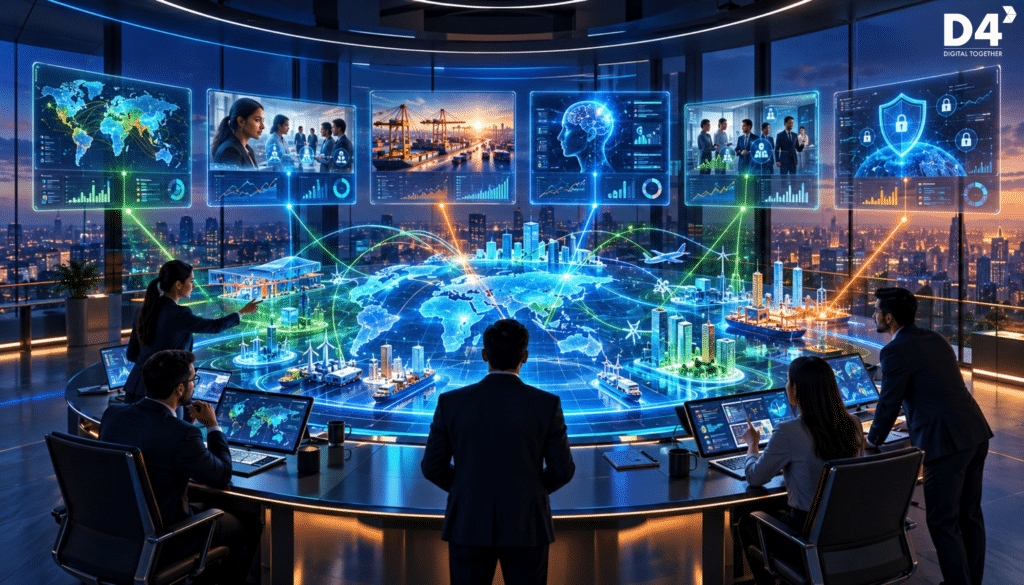
From Dashboard to Digital Twin
Most enterprises today operate through dashboards.
Dashboards tell us what happened.
Predictive analytics tells us what might happen.
A Digital Twin Enterprise asks a much more powerful question:
“What would happen if we did this?”
That changes the equation:
Data → Insight → Prediction → Simulation → Decision → Action → Feedback
AI provides intelligence. IoT provides signals. Analytics provides patterns. Cloud provides scale. Simulation provides possibilities.
And the GCC can bring these capabilities together into one continuously learning environment.
The result isn’t a static model. It is a living enterprise mirror.
The GCC as a Nerve Centre
Imagine a global bank considering a major change in its operating model.
Instead of relying solely on spreadsheets, workshops and historical benchmarks, its GCC could create multiple simulated futures:
What happens to customer experience? What happens to operational costs?
Where could risk increase? Which processes become bottlenecks?
Where might AI create capacity? What happens if market conditions change?
The leadership team isn’t choosing between opinions anymore.
It is exploring possible futures.
That could fundamentally change the role of the GCC from delivery centre to enterprise nerve centre.
But Here Comes the Difficult Question
A digital twin can simulate thousands of scenarios.
But should it decide? Probably not.
Because the more powerful the simulation becomes, the more important human judgment becomes.
Who defines the assumptions? Who decides which risks are acceptable?
What happens when the model’s recommendation conflicts with strategic intent?
And perhaps the most uncomfortable question:
If the digital twin predicts a future we don’t like, will leadership listen or simply change the assumptions until it tells us what we want to hear?
The technology may be sophisticated. The governance must be even more sophisticated.
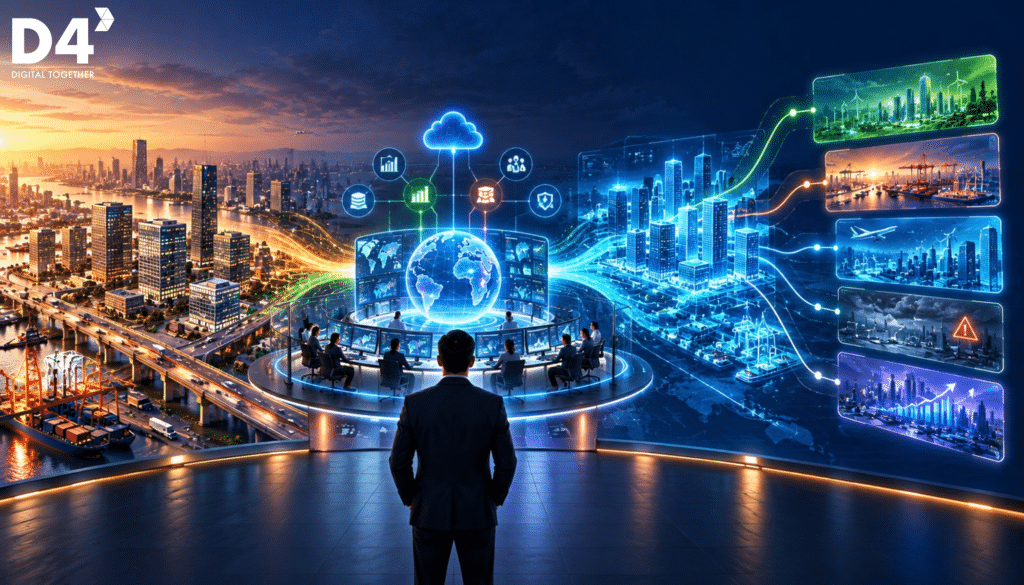
The Technology Behind the Twin
Building a Digital Twin Enterprise isn’t about buying one AI platform.
It requires the orchestration of data, AI, cloud, enterprise applications, cybersecurity, analytics, automation and digital engineering into an interconnected environment.
This is where D4 Insight can act as a technology partner, helping organizations connect these capabilities and build the digital foundations needed for more intelligent, simulated and outcome-driven decision-making. D4 Insight’s capabilities span data and AI, cybersecurity, CRM, consulting and digital transformation services.
The opportunity is to help GCCs move from:
“We execute what the enterprise decides.”
to:
“We help the enterprise understand what could happen next.”
The Bigger Idea
The ultimate GCC may not be the one with the most people.
Or the most applications.
Or even the most AI.
It may be the one that can model the enterprise better than anyone else. Because the competitive advantage of tomorrow may not come from reacting faster.
It may come from seeing more possible futures before choosing one.
The factory had its digital twin. Perhaps the enterprise is next.
And perhaps the GCC will be where that twin lives.
#D4Insight | #PossibilitiesDefineUs | #DigitalTogether