

When Every Desk Becomes an AI-Powered Command Centre
For years, the evolution of Global Capability Centers followed a familiar trajectory.
GCC 1.0 was about cost.
GCC 2.0 was about capability.
GCC 3.0 is about intelligence.
And the most disruptive change may not be that GCCs are building AI platforms.
It is that every employee inside the GCC could soon have one.
Imagine a financial analyst whose AI copilot continuously reconciles data, detects anomalies and prepares scenarios. A software engineer whose agent writes, tests and documents code. A procurement specialist whose AI tracks suppliers, predicts risks and recommends negotiations. A project manager whose copilot identifies delivery risks before they appear on the dashboard.
The employee doesn’t disappear.
The employee’s definition changes.
Recent GCC research points in this direction: more than 75% of GCCs surveyed by Accenture have moved beyond AI experimentation toward scaling AI and automation for business outcomes, while 70% expect to invest in agentic AI within the next two years.
This creates a fascinating question:
If everyone has a copilot, what becomes the GCC’s competitive advantage?
It won’t be access to AI.
It will be how intelligently the GCC orchestrates AI.
The Rise of the “AI-Enabled Employee”
The traditional GCC measured productivity through utilization, throughput, SLAs and headcount.
GCC 3.0 introduces a different equation:
Human expertise × AI capability × enterprise context = exponential capacity
The competitive advantage shifts from how many people can we deploy? to how much intelligence can each person command?
That changes workforce planning, career paths, operating models and even the physical design of the GCC.
A junior analyst with the right AI environment may execute work that previously required multiple layers of manual analysis. A small engineering team can potentially prototype, test and deploy at dramatically greater speed.
But there is a catch.
AI doesn’t automatically create intelligence. It amplifies the system around it.
Bad processes become faster bad processes. Fragmented data produces faster confusion. Poor governance creates faster risk.
And uncontrolled AI adoption can create something even more dangerous:
Agent sprawl.

From AI Copilots to AI Colleagues
The next leap is not simply asking AI to help employees.
It is allowing AI agents to execute parts of the workflow.
One agent monitors.
Another analyzes.
Another prepares.
Another executes.
The human provides judgment, accountability and direction.
This is where GCC 3.0 becomes genuinely interesting.
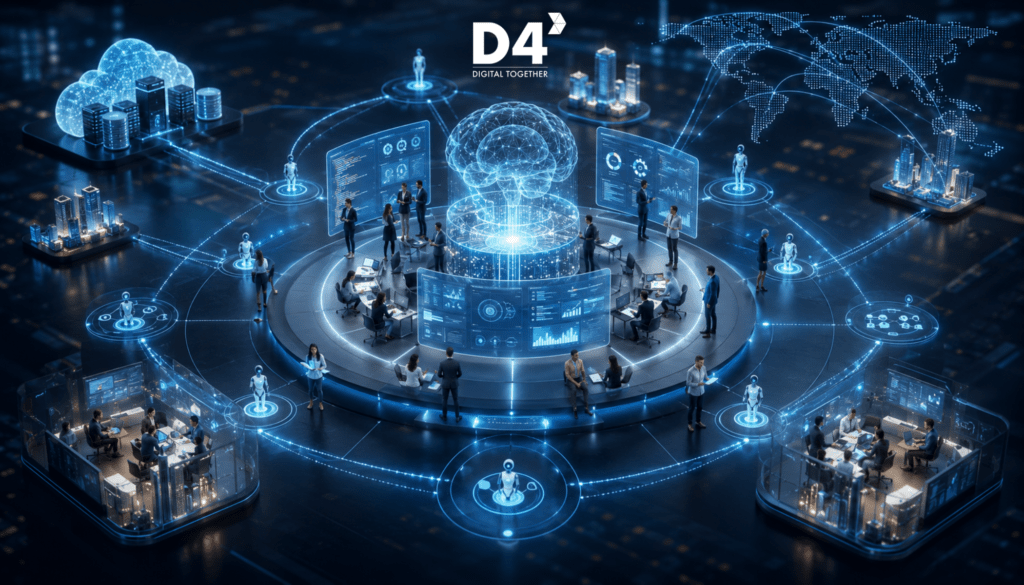
The GCC starts to look less like a collection of functional teams and more like an intelligent operating system connecting people, data, applications, AI agents and business decisions.
But that raises uncomfortable questions.
Who owns an AI-generated decision?
How much autonomy should an agent have?
What happens when an employee’s copilot knows more about a process than the employee does?
And perhaps the biggest question:
If AI multiplies individual productivity, should GCC growth still be measured by headcount?
The New GCC Scorecard
GCC 3.0 may need to retire some old metrics.
Instead of celebrating 10,000 employees, imagine celebrating:
10,000 AI-augmented professionals.
500 intelligent workflows.
100 autonomous business processes.
50 decisions redesigned through AI.
10x faster innovation cycles.
The unit of scale is no longer the employee.
It is the employee’s augmented capacity.
This is where a technology partner like D4 Insight can play a critical role – not simply by implementing AI tools, but by helping GCCs connect AI, data, cloud, automation and enterprise applications into governed, outcome-driven operating models.
The real opportunity is not to give everyone another chatbot.
It is to build an ecosystem where every employee can command intelligence safely, contextually and responsibly.
Because the defining question for GCC 3.0 isn’t:
“How many people does our GCC employ?”
It is:
“What can our people accomplish when every one of them has intelligence on demand?”
That may be the real transformation.
And perhaps, for the first time, the most powerful capability inside a GCC won’t be a technology platform.
It will be every employee.
– D4 Insight | Enabling the Intelligent Enterprise