
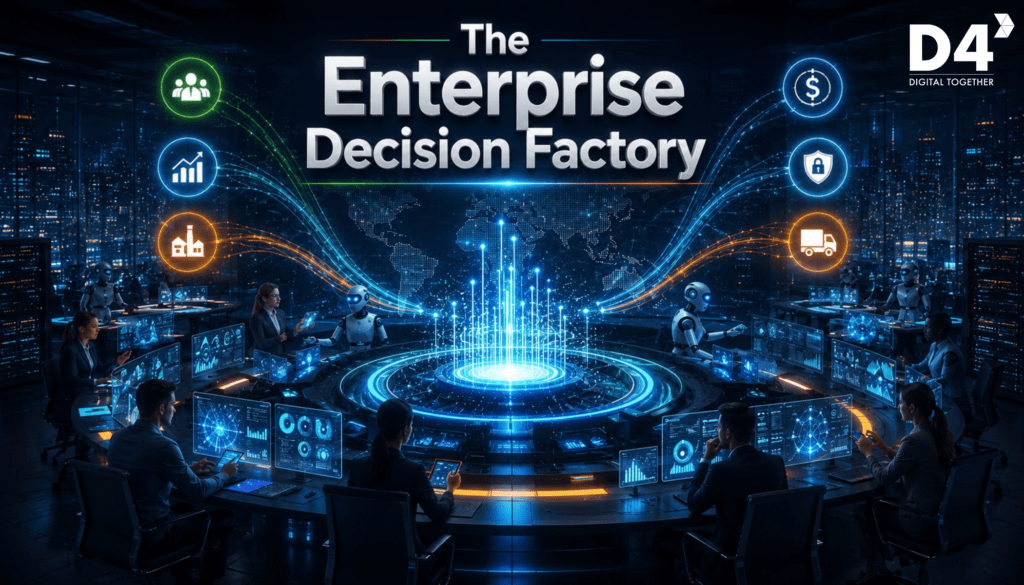

The Enterprise Decision Factory
For decades, the Global Capability Centre (GCC) was built around a simple equation:
Headquarters decides. The GCC delivers.
GCCs became exceptionally good at engineering, analytics, operations, technology support and process execution.
But AI is changing the economics of execution.
When machines can write code, analyse millions of data points, automate workflows and increasingly execute complex tasks, the competitive advantage shifts.
From doing more to deciding better.
That could make the next-generation GCC something far more powerful than a delivery centre.
It could become an Enterprise Decision Factory.
The New Bottleneck Isn’t Execution. It’s Judgement.
Modern enterprises generate enormous volumes of signals every second.
Customer behaviour changes. Markets move. Fraud patterns evolve. Cyber threats emerge. Regulations shift. Supply chains fluctuate. AI models generate recommendations.
The challenge is no longer simply accessing information.
It is answering:
What should we do? What should we stop doing? What deserves investment? What requires escalation? What can be automated, and what should never be?
This is where the GCC can evolve.
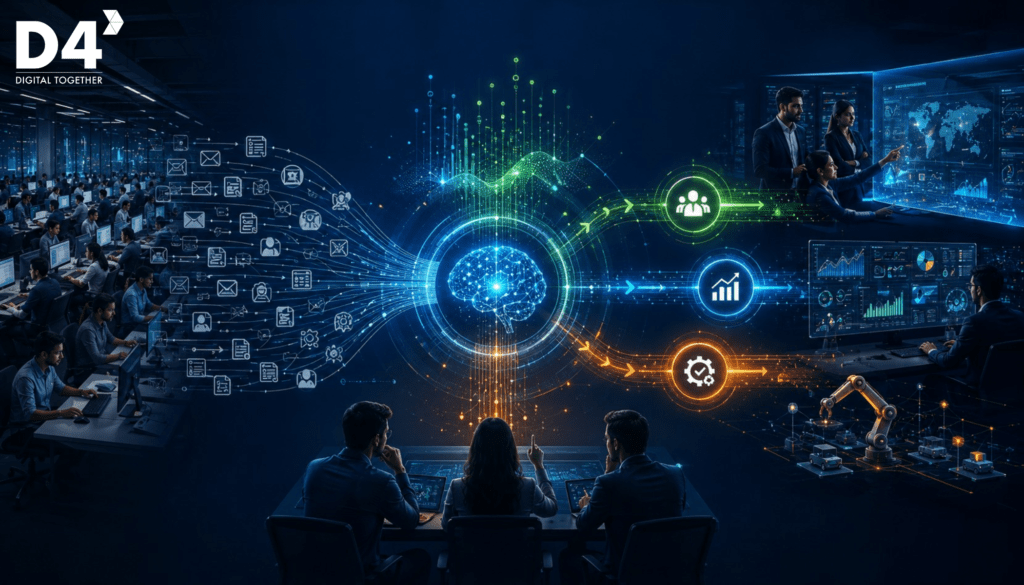
Instead of simply producing reports, applications or operational outcomes, it can increasingly build and operate the decision loops that run the enterprise.
The model changes from:
Data → Insight → Dashboard
to:
Signal → Intelligence → Decision → Action → Feedback → Learning
That is the Decision Factory.
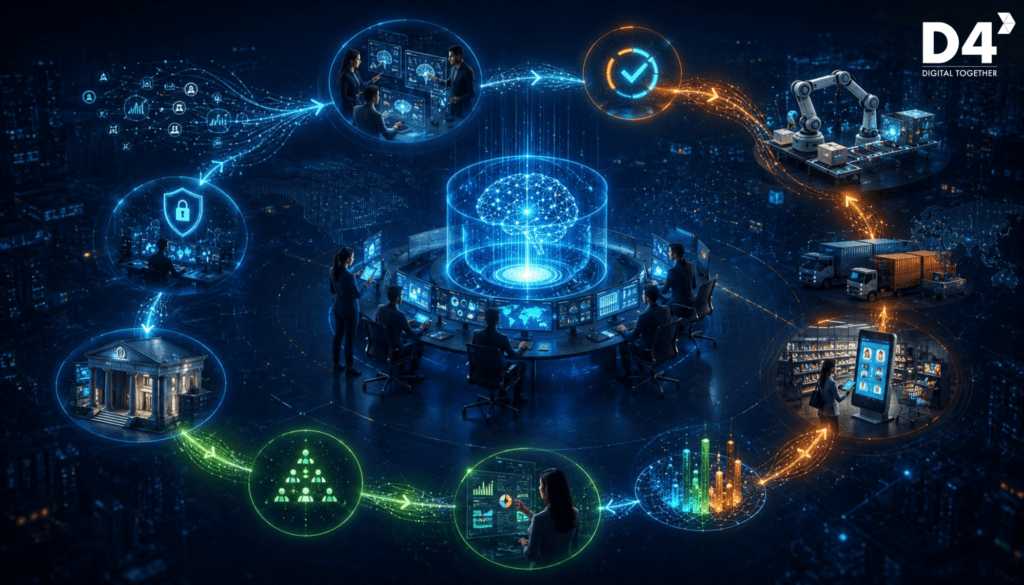
Where Intelligence Meets Action
Imagine a banking GCC that doesn’t simply build fraud analytics, but continuously detects emerging patterns, recommends interventions, triggers approved actions and learns from the outcome.
Or a retail GCC that moves beyond forecasting demand to dynamically influencing pricing, inventory and customer engagement.
Or a manufacturing GCC that combines IoT, AI and supply-chain intelligence to determine where intervention will create the greatest business impact.
In each case, the GCC is no longer just supporting the business.
It is helping the business decide.
But There Is a Catch
The more decisions AI can influence, the more important governance becomes.
Who owns the decision?
What data influenced it?
When should humans intervene?
Can an AI recommendation be challenged?
How do you audit an autonomous action?
And perhaps the most uncomfortable question:
If the machine is consistently right, will humans still have the courage to override it?
The Decision Factory therefore needs more than AI.
It needs trust, governance, cybersecurity, domain expertise and human judgement.
Building the Decision Factory
This requires a different GCC blueprint.
Trusted data foundations. Cloud-native platforms. AI and GenAI embedded into workflows. Secure digital infrastructure. Strong identity and cybersecurity controls. Product-oriented engineering. And, most importantly, multidisciplinary teams combining technology, business expertise and decision science.
This is where D4 Insight can be a technology partner.
With capabilities spanning Data Engineering & Analytics, Cloud Modernization, GenAI, Cybersecurity, IAM, Salesforce, Microsoft Dynamics and Digital Engineering, D4 Insight can help enterprises build the technology foundation required to turn intelligence into secure, actionable decisions.
The goal isn’t simply to build a GCC.
It is to build a GCC capable of learning, deciding and transforming at enterprise scale.
The Question Has Changed
The old GCC question was:
“How much work can our GCC handle?”
The new question could be:
“How much of our enterprise can our GCC help us understand, decide and transform?”
That is a very different ambition.
Because when execution becomes increasingly automated, decision quality becomes the differentiator.
The GCC of the future may not sit at the edge of the enterprise.
It may become its cognitive centre.
And the organisations that build that capability early could discover that their greatest GCC advantage isn’t how much they can deliver.
It’s how intelligently they can decide what to do next.