
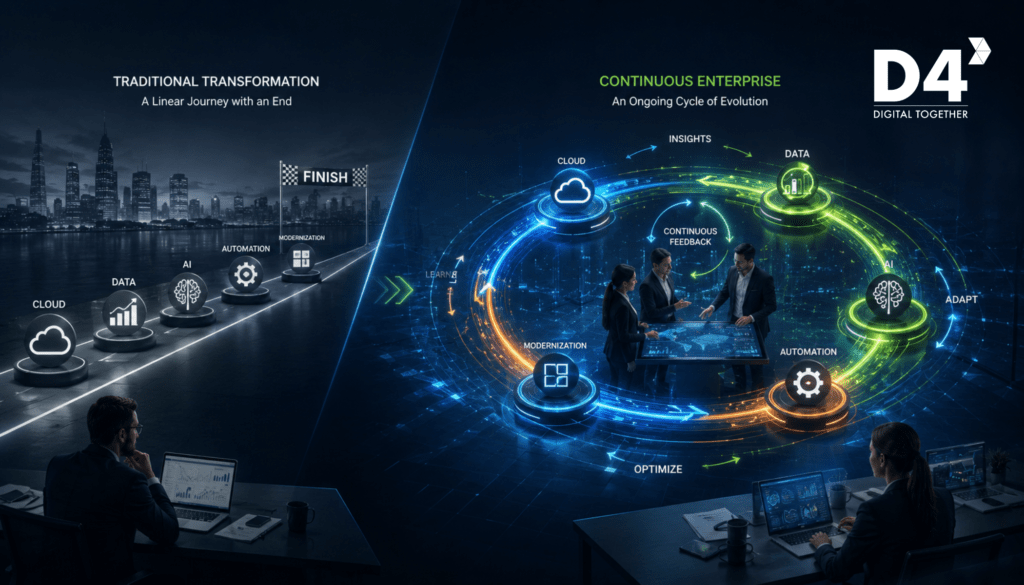
For years, organizations have treated digital transformation like a destination.
A three-year roadmap.
A cloud migration.
A new ERP.
A data modernization program.
An AI strategy.
A transformation office.
A launch.
A celebration.
And then… what?
The uncomfortable question is this:
What happens when transformation is “complete” in a world that refuses to stand still?
The answer is simple: the organization starts falling behind.
The future of digital transformation is not transformation at all.
It is continuous evolution.
Welcome to the Continuous Enterprise – an organization designed not merely to adopt technology, but to continuously adapt its business, operating model, workforce and customer experience as technology and markets change.
The Problem With the Transformation Mindset
The word transformation itself creates a dangerous mental model.
It implies a beginning, a middle and an end.
Organizations often launch transformation programs with a defined scope, budget, timeline and success criteria. That makes sense from a project-management perspective.
But markets don’t operate like projects.
Customers don’t wait for the next transformation phase. Competitors don’t pause because your ERP implementation is still underway. AI doesn’t wait for your three-year digital roadmap. New business models can emerge before yesterday’s transformation program has reached production.
The technology changes faster than the transformation cycle.
That creates a paradox:
The better an organization becomes at completing transformation projects, the greater the risk that it starts thinking transformation is something that can be completed.
It cannot.
From Transformation Projects to Transformation Capability
The Continuous Enterprise operates differently.
Instead of asking:
“What should we transform next?”
it asks:
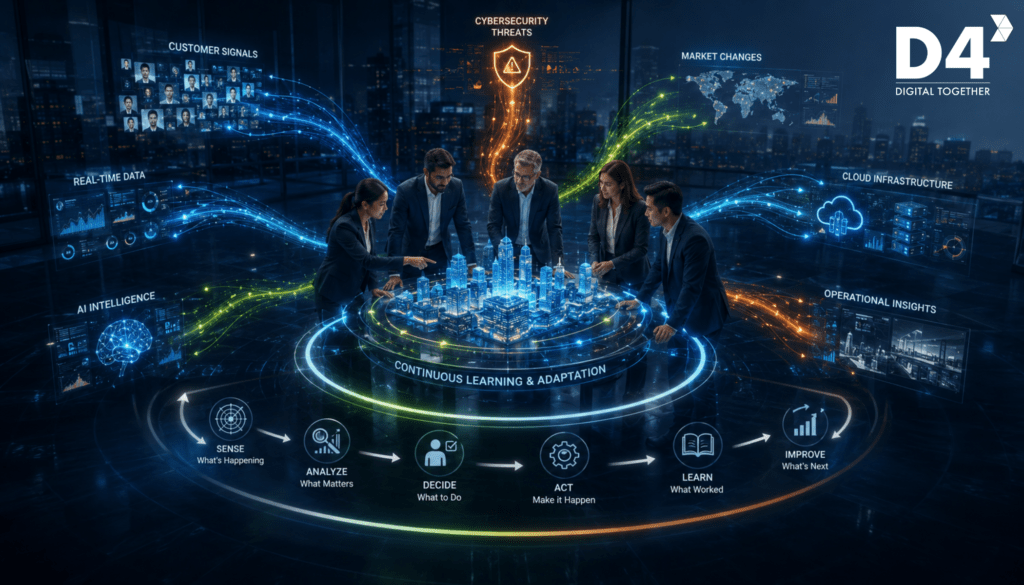
“How quickly can we sense change, decide what matters, and respond?”
That is a fundamentally different leadership question.
It shifts the focus from individual technologies to organizational capabilities.
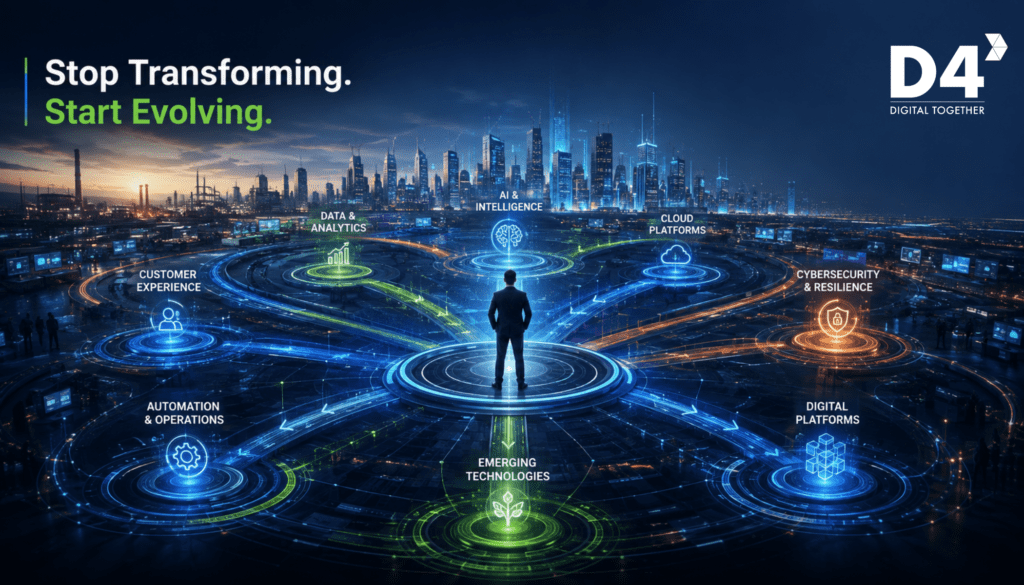
Cloud becomes more than infrastructure – it becomes elasticity.
Data becomes more than reporting – it becomes organizational sensing.
AI becomes more than automation – it becomes an additional layer of intelligence.
Cybersecurity becomes more than protection – it becomes resilience.
Managed services become more than operational support – they become an engine for continuous optimization.
And technology teams become more than implementers – they become partners in business evolution.
The New Competitive Advantage: Adaptability
Tomorrow’s strongest enterprise may not be the one with the most advanced technology.
It may be the one that can change direction fastest without destabilizing the business.
Think about two organizations.
Both have modern cloud platforms.
Both use AI.
Both have advanced analytics.
Both have automated processes.
But one takes nine months to introduce a new digital capability because every change requires multiple approvals, legacy dependencies and transformation projects.
The other experiments, learns, integrates and scales continuously.
Who has the digital advantage?
Not necessarily the one with better technology.
The advantage belongs to the organization with a better rate of adaptation.
That is the real architecture of the Continuous Enterprise.
What Does a Continuous Enterprise Look Like?
It is an organization where transformation becomes embedded into the operating model.
Technology platforms are continuously modernized.
Processes are continuously measured and redesigned.
AI models continuously learn and improve.
Cybersecurity continuously adapts to new threats.
Customer journeys continuously evolve based on behavior.
Employees continuously develop new skills.
And managed services continuously identify opportunities to improve performance, resilience, automation and cost – not simply keep systems running.
The question shifts from “Is the transformation successful?”
to:
“Is the enterprise becoming better at transforming itself?”
That distinction changes everything.
The Role of a Technology Partner Changes Too
This is where partners such as D4 Insight can play a different role.
A traditional technology partner may be measured by whether a system was implemented successfully.
A Continuous Enterprise needs something more enduring: a technology partner capable of helping it sense, modernize, optimize and evolve continuously.
Through capabilities spanning cloud and infrastructure modernization, data and analytics, Salesforce and Microsoft Dynamics, DevOps, cybersecurity, automation, GenAI and digital engineering, D4 Insight can support organizations beyond the traditional “go-live” moment.
The opportunity is to move from project partner to continuous transformation partner – helping organizations modernize platforms, optimize operations, introduce intelligent automation, strengthen resilience and continuously identify what should change next.
Because the most valuable transformation conversation may no longer be:
“When will this project finish?”
It may be:
“What will we be capable of doing next?”
The Enterprise of Tomorrow Has No Finish Line
Perhaps the most important shift is cultural.
Organizations must stop rewarding transformation only when something is completed.
They need to reward learning.
Experimentation.
Adaptation.
Speed.
Resilience.
And the courage to redesign something that was considered “finished” yesterday.
Because in a world shaped by AI, geopolitical uncertainty, changing customer expectations and accelerating technology cycles, standing still is no longer neutral.
Standing still is a strategic decision.
The Continuous Enterprise understands this.
It does not chase a mythical digital end state.
It builds the capability to continuously reinvent itself.
And perhaps that is the real definition of digital transformation:
Not becoming digital once.
Becoming capable of change – again and again.
D4 Insight | Digital Together.