
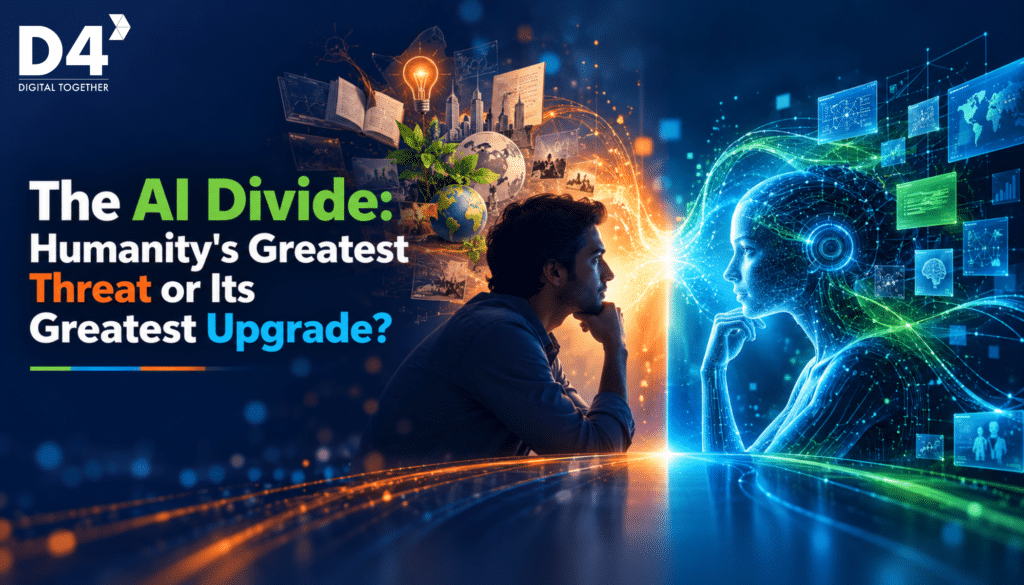

The AI Divide: Humanity’s Greatest Threat or Its Greatest Upgrade?
“Every technological revolution has changed how we work. AI is the first one challenging how we think.”
From the printing press to the internet, every technological leap has triggered fear before it created acceptance. Artificial Intelligence is no different – except this time, the disruption feels far more personal.
The question echoing across boardrooms, universities, workplaces, and social media isn’t simply:
“Will AI take our jobs?”
The deeper question is:
What happens when intelligence itself becomes something machines can replicate?
The future of AI isn’t approaching.
We’re already living it.
AI Has Moved From Experiment to Everyday Work
Whether it’s generating content, writing code, summarizing meetings, translating languages, analyzing data, or supporting customers, AI has quietly become part of everyday work.
But unlike earlier waves of automation that primarily replaced physical or manual effort, AI is beginning to automate cognitive work – tasks once considered uniquely human.
The impact is already visible.
Routine administrative work, basic customer support, documentation, translation, data analysis, and repetitive programming are increasingly becoming candidates for automation.
At the same time, the emergence of AI is creating demand for new skills and new forms of work. The value of many roles is shifting from simply doing the task to understanding the problem, directing the technology, validating the outcome, and making decisions around it.
History tells us that technology rarely eliminates work altogether.
It transforms what work means.
The real challenge, therefore, isn’t simply whether jobs will disappear.
It’s whether people, skills, and organizations can evolve as quickly as technology does.
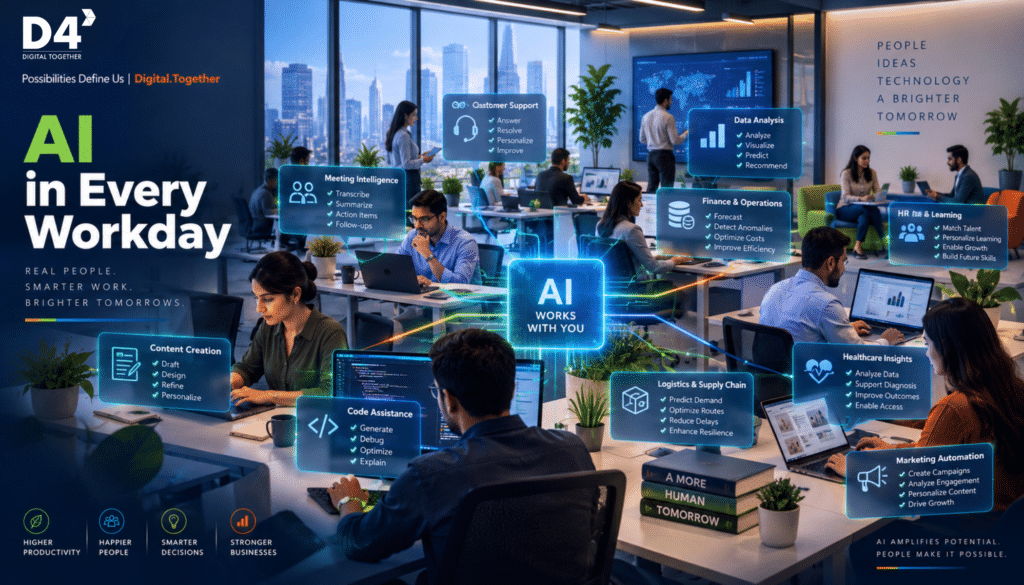
AI Doesn’t Need to Replace You. It Just Needs to Replace the Task.
This is where the conversation needs to shift.
AI excels at recognizing patterns, processing enormous amounts of information, generating content, and executing repeatable tasks with remarkable speed.
In other words:
AI thrives where work becomes predictable.
And there’s an irony here.
Organizations have spent decades standardizing processes to make work faster, more consistent, and more efficient.
Those same characteristics now make many processes easier to automate.
What becomes increasingly valuable, therefore, are capabilities that require context, judgment, creativity, empathy, collaboration, ethical reasoning, and the ability to navigate ambiguity.
The future may not belong to those who compete with AI.
It may belong to those who learn how to think, create, decide, and collaborate with it.
AGI: The Threshold We Haven’t Crossed – Yet
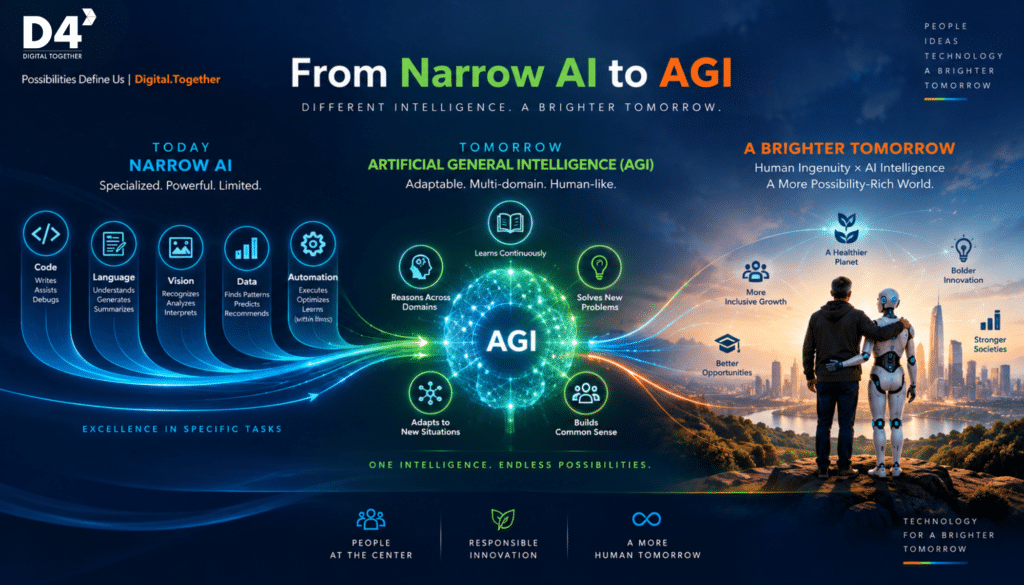
Today’s AI is powerful, but largely specialized.
It can write, analyze, code, generate images, summarize information, and perform increasingly sophisticated tasks. Yet it still operates within the capabilities and boundaries of its design.
Artificial General Intelligence (AGI) represents a very different possibility.
An AGI system would theoretically be capable of learning across domains, adapting to unfamiliar situations, transferring knowledge between problems, and performing a broad range of intellectual tasks with a level of flexibility closer to human intelligence.
AGI does not exist today. But its potential is one reason conversations around AI have expanded beyond innovation and productivity into questions of ethics, governance, safety, and control.
The question isn’t simply how intelligent AI can become.
It is also:
How do we ensure that increasing intelligence is developed and deployed responsibly?
The Next Competitive Advantage Is Human + Machine
AI should not be viewed simply as a cost-cutting tool. Its greatest value lies in augmenting human potential, enabling people to focus on strategic thinking, innovation, and solving complex problems that require context and judgment.
Organizations that invest only in AI technology may gain efficiency.
Organizations that invest equally in people, skills, governance, and responsible AI adoption will build lasting competitive advantage.
This is where trusted technology partners become essential. At D4 Insight, we help enterprises move beyond AI experimentation by integrating intelligent automation, data modernization, cloud transformation, and enterprise AI solutions into practical business strategies. Our focus is not just on adopting AI – but on ensuring it delivers measurable outcomes while keeping people at the center of transformation.
If Intelligence Is No Longer Uniquely Human, What Makes Us Human?
Perhaps AI isn’t humanity’s greatest threat.
Perhaps it’s our greatest mirror.
It exposes repetitive work, outdated processes, inefficient systems, and skills that may no longer create the same value they once did.
But it also highlights what makes us distinctly human – curiosity, imagination, empathy, judgment, creativity, and the ability to see possibilities beyond patterns.
So perhaps the real question isn’t:
“Are we doomed?”
It is:
“How do we redefine ourselves in an age where intelligence is no longer uniquely human?”
The organizations and individuals, that begin answering that question today may shape not just the future of work, but the future of how work itself is defined.